Thermontology

2026-10-08
2.4.0 Now I want to talk about the weirdest feature of our universe's laws, the fact that they are quantum mechanical. As you may be aware, quantum-level processes interact oddly with measurement.
2.4.0.1 In particular, the state of a quantum system is represented as a complex-valued "wavefunction"; when measured the system stochastically collapses to a given value depending on the total amplitude of the complex function in the region(really, basis vector) corresponding to the value. Before measurement, parts of this wavefunction can interfere with each other and cancel out; after measurement, parts of the wavefunction corresponding to different measurement outcomes no longer interfere in this way.
2.4.0.2 So what's going on when we make a measurement? Physically, what even is a "measurement"? Can we give an account of "measurement" which does not bake in a privileged set of degrees of freedom which we take as being "measured"?
2.4.0.3 The answer I like the best, quantum darwinism, says that measurements occur when some local piece of information is copied in many places. This determines both when things get measured, and the "basis" they are measured in(this term to be explained later).
2.4.0.4 To get a feel for how this works, first let's review some natural and artificial processes that proliferate copies of information. This can mostly be done in a classical setting.
2.4.0.4.1 To clarify what we're talking about here, by "information proliferation" I have in mind the following: some sort of system with spatial locality, e.g. a cellular automaton or fluid, is being evolved in time. We take some small local subset -- perhaps a single tile of the automaton or bounded subset of the fluid -- and perturb it. How does this change the system's evolution? In particular, we can compare the evolution of the original state of the system (say A) to the perturbed version(say B). Does the difference between A and B stay localized to the vicinity of the perturbation, or does it spread?
2.4.0.4.2 In popular science, information proliferation is sometimes illustrated with the apocryphal "butterfly effect". Due to the turbulent nature of the weather, a butterfly flapping its wings in Brazil could lead to a tornado forming in Texas several months later(as far as I know this is a plausible thing that could happen, although it seems like it would be very hard to be in a position to know)
2.4.1.1 So what sort of spatially localized systems lead to information proliferation? In a sense, most of them, especially when the systems are measure-preserving.
2.4.1.1.1 Why do I say this? Well, if we consider a "generic" local interaction, and a random change to some local state, the "generic" consequence is for the change to proliferate indefinitely throughout the system.
2.4.1.1.2 Concretely, we might imagine a cellular automaton with randomly chosen rules(say, a random mapping from a cell's 3x3 neighbourhood to its next state). As the local state space dimension increases, I believe the probability that a random local perturbation of a random state proliferates, goes to 1.
2.4.1.1.3 This effect becomes even stronger for systems which are reversible. This is because one way that systems can fail to proliferate is for the effects of a perturbation to "die out" early, i.e. for the differences between the unperturbed and perturbed systems to vanish. For instance, changing a single square in an empty GoL from dead to alive fails to proliferate because it is erased on the next step.
2.4.1.1.4 This means that any perturbation of a measure-preserving system must leave a "record" somewhere in the system, the only question is whether the record remains localized or spreads. For "generic" measure-preserving systems -- say, a random reversible block-partitioned cellular automaton -- again we have that the probability of proliferation goes to 1 as the local dimension increases.
2.4.1.2 Now of course, as discussed in the previous section, we don't live in a random universe, but a very specific one. How do the features of the laws discussed in the last section(free energy local minima, etc) affect information proliferation?
2.4.1.3 If we picture the universe being made of a collection of interacting systems in local free energy minima, this might seem to decrease the expected amount of proliferation, since a perturbation that only slightly disturbs a local minimum will have its effects erased. However, this neglects the fact that the lost energy must be transferred as heat or work to another system, which will retain a (perhaps very scrambled) record of the perturbation.
2.4.1.3.1 Let's consider an example in our universe. Say you are spinning a pen on a table by pushing on one end. Now as covered in the last section, relative displacement of the atoms within the pen is converted to sound waves and the overall rotational and translational motion of the pen. Friction with the table then dissipates the kinetic energy into minute oscillations of the atoms in the table, which are dissipated into even more minute oscillations of the floor, thence the ground.
2.4.1.3.2 Ultimately the additional energy is radiated into space. Thereafter the photons radiated in this way propagate indefinitely(unless they hit a planet or something, but this is relatively unlikely).
2.4.1.4 A larger number of records can be created in situations where the local minima themselves change. One striking way this can happen is in situations where a local minimum releases more energy when perturbed(in the course of falling to a lower minimum) than the energy needed to perturb it. If near other systems with this property, this can set off a chain reaction.
2.4.1.4.1 Examples in nature include avalanches(cascades of gravitational potential energy) and fires(chemical potential energy).
2.4.1.4.2* The field of study known as self-organized criticality studies toy models of these types of dynamics. Examples include the Abelian sandpile model and the forest-fire model. These models are said to exhibit "self-organized criticality" because they can produce outputs with "critical" correlation statistics across different levels of scale, i.e., they have non-trivial correlations at all scales(although in fact, the original forest-fire model was later discovered to not actually be critical in this sense, although variants are)
2.4.1.4.2.1* The Abelian sandpile model is defined on a grid. On each grid cell a nonnegative integer amount of "sand grains" are placed. If a grid cell has more than 3 grains on it, it will topple, i.e. disperse 4 grains to its immediate neighbors. The order that this is done in does not affect the final configuration(hence the name "Abelian"). Adding grains one at a time will cause "avalanches" of different sizes.
2.4.1.4.2.2* The forest-fire model is a family of models likewise defined on a grid, which share the basic dynamics of a randomly-growing set of "tree" squares through which "fires" occasionally spread, sparked by random "lightning strikes", and spreading to adjacent neighbours. (Only some variants of the FF model are "critical" in a technical sense)
2.4.1.5 Not all information-proliferating dynamics in nature need to involve cascades of energy release like this. In turbulent fluids, for instance, perturbing a small part of the fluid will generically cause the trajectory of the whole to diverge, regardless of whether the perturbation "releases energy".
2.4.1.6 The world as a whole, of course, has far more complex dynamics that can amplify the effect of small changes. For instance, a cat might respond to a falling rock by running away, where it could meet other cats, or startle a bird, causing further unpredictable cascading changes. Humans can even more so act as amplifiers of small changes, and in fact we deliberately build devices to measure such in finer detail. This will be the subject of the next subsection.
2.4.2.1 The overall goal of this section is to give some background for a theory of the quantum measurement problem, so it seems worth examining some examples of measurement devices in more detail.
2.4.2.2 Photomultiplier Tubes. A very clear example of information amplification. Photomultiplier tubes(PMTs) are devices designed to detect very small amounts of light, e.g. single photons. To do this, they couple a photocathode -- a substance which emits electrons when struck by light -- to a series of dynodes, plates at successively higher voltage, having the property that they emit electrons when struck by an electron moving at sufficient velocity. The material in these dynodes is chosen so that multiple electrons are emitted for each incoming electron, producing an exponential cascade of electrons. By the end of the tube millions of electrons can be produced by a single incoming photon, producing an noticeable electrical pulse.
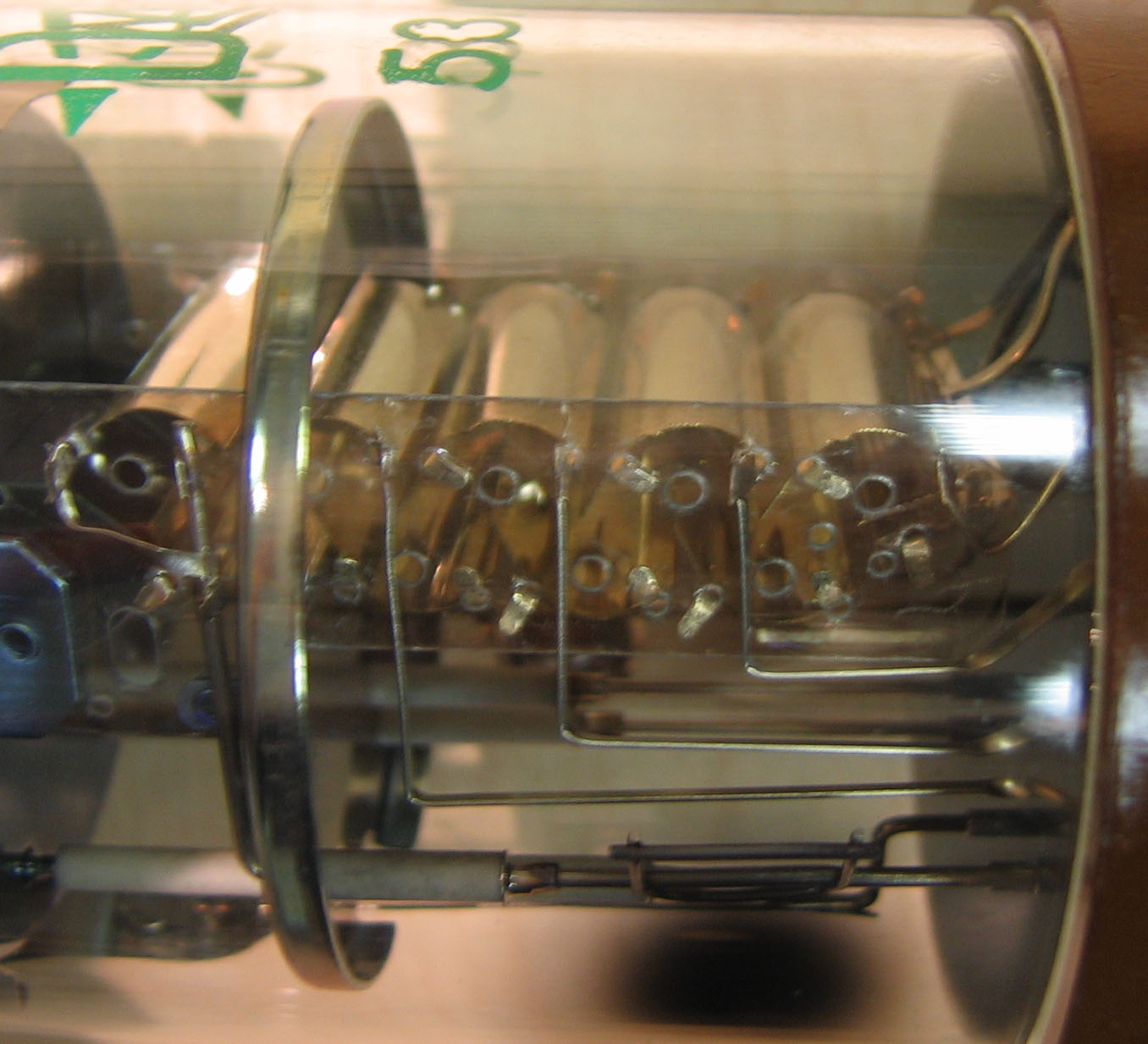
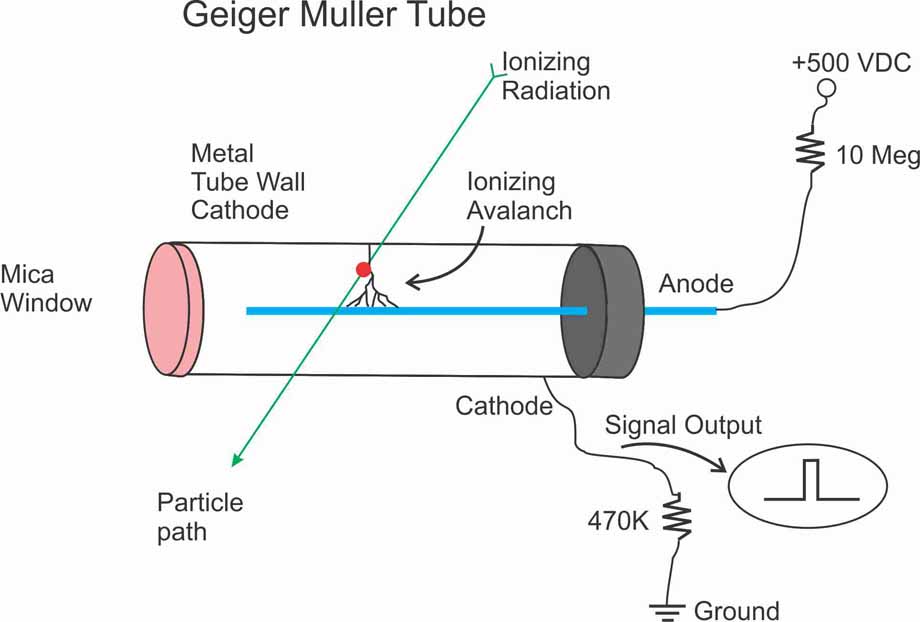
2.4.2.3 Geiger Counters. Geiger counters detect high-energy radiation(e.g. alpha and beta particles and gamma rays). They contain a tube filled with an electrically neutral gas, containing a metal rod and metal walls. The walls and rod are held at different voltages, producing an electric field. When a high-energy particle strikes a gas molecule, it may be ionized, i.e. produce a free electron and ion. The electron is accelerated towards the wire and may strike other gas molecules, ionizing them and releasing further electrons, again producing an electron cascade which gives rise to an electric pulse(producing the familiar "click" of the Geiger counter). Cascades will also typically release high-energy photons which set off additional cascades, strengthening the avalanche effect.
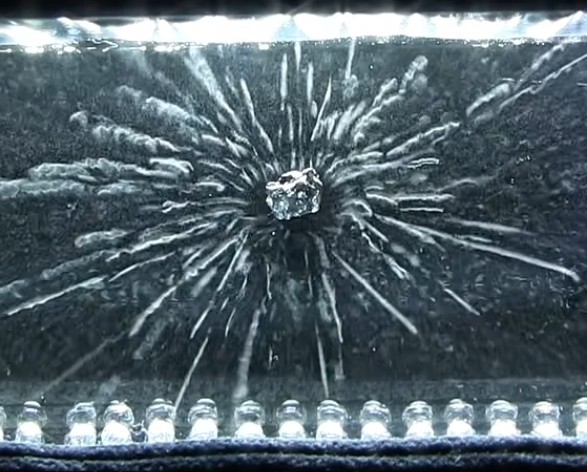
2.4.2.4 Cloud chambers. Unlike the last two examples, cloud chambers do not produce an exponential cascade. Instead, they consist of a gas cooled to a metastable "supersaturated" state on the verge of condensation. A high-energy particle moving through the gas will disturb the metastable state and ionize some molecules. Other molecules condense around the ions, producing a visible trail of droplets. These droplets can contain millions of molecules, so tremendous information amplification still takes place.
2.4.2.5 Lenses. Lenses consist of a transparent material, with a refractive index different from its surroundings, shaped in such a way that incoming planar light waves are (approximately) converted to spherical waves with their center at the focus of the lens. Unlike the previous examples, lenses do not create additional records or copies of the information in their input signal, but they do convert it to a form that can be more easily recorded(e.g. by the rods and cones in the eye).
2.4.2.6 Ultimately measurement devices, when used in human civilization, will create still further records by means of the state of the brains of the humans who examine them, electronic or paper records, and the downstream consequences of these things. As in the examples in the last section, this will ultimately lead to photons(and gravitons, potentially) propagating away from Earth.
2.4.2.7 So that's a brief overview of how information is propagated and amplified in our world, mostly at a classical level. The next section will examine how the notion of information propagation can be used to solve the quantum measurement problem!